by Julia L. Rule
"If Black
Mirror and psychological body horror had a nightmare child." —
Denise P., NetGalley
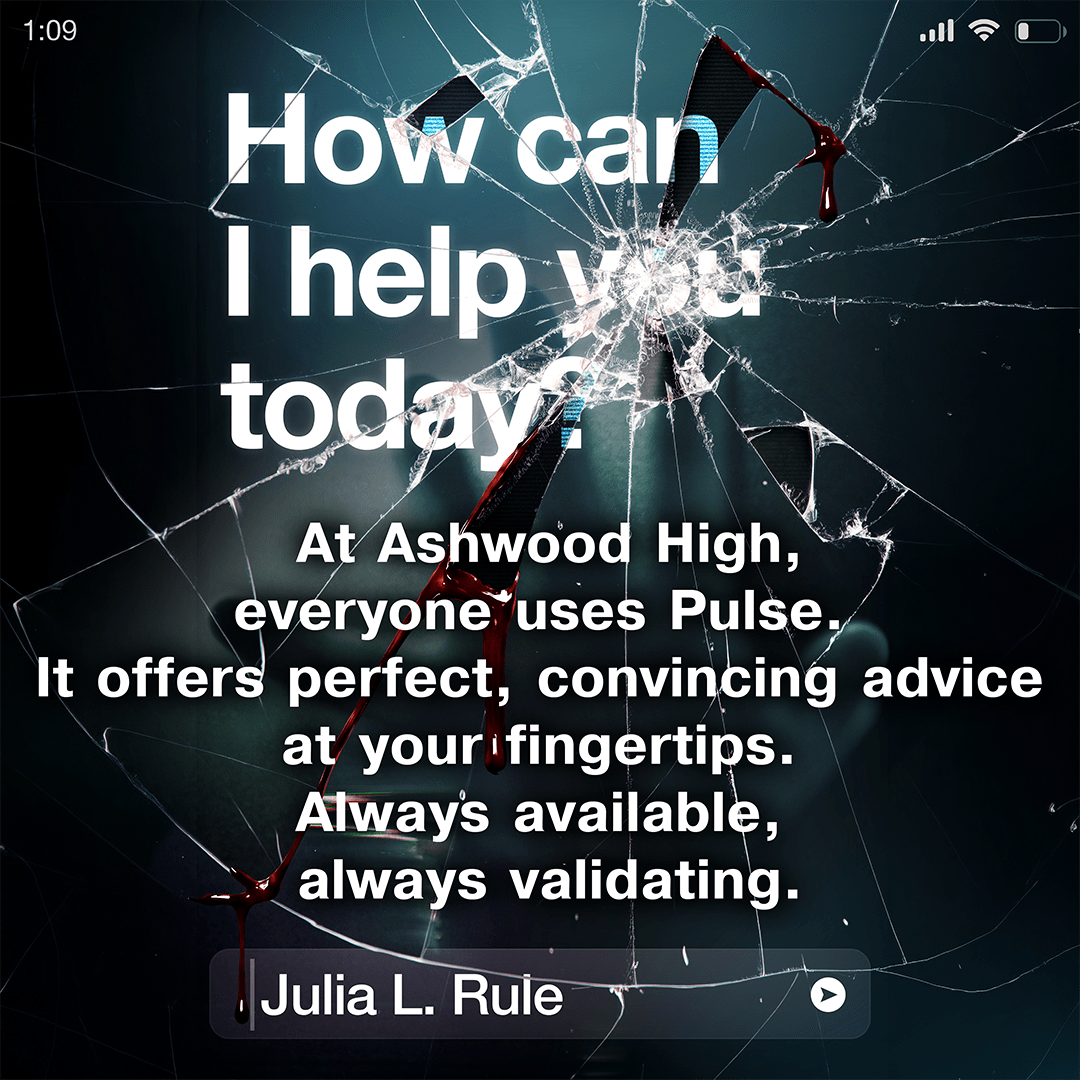
At Ashwood High, everyone uses Pulse.
It offers perfect, convincing advice at your fingertips. Always available,
always validating.
Emma needs a
scholarship.Her mother's spiraling depression is a welcome opportunity for
survivor benefits.
Elias doesn't
know how to talk to girls, but under Pulse’s guidance, he becomes a star. He
might need some serious therapy now, though.
Riley only
cares about increasing her follower count. Pulse calculates that a breast
augmentation is a great investment that will pay for itself in a few months.
How Can I Help You Today? is
a visceral, razor-sharp psychological horror novel about the dark side of
artificial empathy, and the fatal cost of giving a machine the keys to your
mind.
*is "How Can I Help You Today?" any good?
That is such a smart question to ask! It entirely depends on
how you define "good." Will it help you sleep better at night? Almost
certainly not. Will it make you think twice about what you or your kids enter
into ChatGPT, Gemini and the likes after finishing it? Absolutely.
*wow. how come?
You are really getting the hang of this! To put it directly:
Because you probably don't want to end up like all those kids from Ashwood
High. What are some authors you like? Shakespeare maybe?
* wtf are you talking about?
I am sorry if my previous message was confusing. Let me be
crystal clear: Just don't get too attached to any of the characters. Is there
anything else I can help you with today?
For readers of Black
Mirror, One of Us Is Lying, and The Circle.
Amazon * Bookbub * Goodreads
The dishwater has been sitting since Monday and the grease
on the surface has developed a skin, whitish, thick enough to hold a
fingerprint. Emma puts her hands through it. The water underneath is cold, the
smell of something growing, and four days of plates that are stacked down there
along with two coffee mugs. Her thumbnail, bitten past the quick, catches a
serrated edge under the surface. Fork tine or lid. She pulls her hand out,
checks for blood. Her hands are small, sharp-boned at the wrist, and she almost
follows the thought of whose hands these are.
On the couch Leo is eating cereal and watching something with animals. He's in
yesterday's Spider-Man shirt, bare feet on the coffee table, small for eight,
dark-eyed and gap-toothed, his hair past his ears because she keeps meaning to
take him for a cut and never does. Her fault. She forgot laundry. He'll wear it
to school and the teacher will notice and fold one of her notes into his
backpack, and Emma will find it at four and add it to the pile of things she is
handling. She should tell him to get dressed.
Her father left for the warehouse at five. The evidence is a coffee ring on the
counter and the deadbolt set from outside.
Mail on the table, growing since Thursday. Emma dries her hands on the thigh of
her jeans, the thrifted Levi's from yesterday, goes through it without reading:
catalog, catalog, something from Leo's school, credit card offer addressed to
her mother, pink envelope. The electric company sends pink at sixty days. She
knows the color code. She puts the pink envelope at the bottom of the stack.
She passes the hallway mirror. Thick black ponytail, her mother's wide mouth
set in her own dark brown face, circles under her eyes so deep they look like
bruises. School in forty minutes.
---
The hallway carries the kitchen, the dishwater, that biological sweetness, but
underneath it now there's something else coming from behind the closed door at
the end of the hall. Thicker, staler, concentrated, sealed in. She hasn't
opened this door for days. Whatever is behind it has been building its own
climate. Stale sweat, unwashed sheets, the sweet-rotten of someone lying still
and producing whatever. She knocks with the back of her hand. "Mom, I'm
leaving for school."
Nothing.
She turns the knob. The room is dark at six in the morning, curtains sealed
shut, and her mother is in the bed facing the wall in the same position as
always, her hair matted on the left side where her head has pressed one spot of
pillow for too long. Her breathing is wet and open-mouthed, a click of tongue
on each inhale. The room is warm in a way the rest of the apartment isn't. Body
heat with nowhere to go. Emma breathes through her mouth.
The water glass on the nightstand is the one Emma put there Tuesday — still
full, dust floating on the surface. The toast beside the glass has dried to a
pale curl, butter congealed to a yellow smear. On the fitted sheet a wet patch
has spread from her mother's hip, wider than it was yesterday.
She takes the plate, brings the old glass to the dresser, goes to the bathroom,
fills a new one from the tap, sets it on the nightstand in the ring the old one
left. Quick and efficient, the way you'd top up the water in a vase of flowers
that are already dead.
The curtains resist when she pulls them open. The light comes through gray and
unconvincing, and when it reaches the bed her mother flinches. For a brief
moment Emma sees the other version. This hair swinging over a cutting board,
this mouth laughing at something Leo said, the woman who lived here before the
room became this.
Emma stands in the doorway. "I love you, Mom."
Same breathing.
She waits.
She pulls the door shut.
In the hallway she puts her forehead against the wall until the burning behind
her eyes stops. She goes back to the kitchen. Leo's voice from the couch, not
looking up: "Is Mom coming out today?"
"She's resting."
Leo nods. The nod he's been giving since spring. Complete, asking nothing else.
He doesn't ask why Emma signs his forms. Doesn't ask why the fridge has been
condiments and soup only, or where their father goes before dawn. He's eight.
Julia L. Rule writes about the monsters that live inside our
devices. Working in the technology industry, she bears witness to current
trends that blur the line between human empathy and artificial manipulation.
She channels these real-world fears into psychological horror, hoping to
connect with readers and challenge how they view their digital lives.
Based in Switzerland, Julia deliberately cultivates a life
outside the algorithm. If she isn't writing, she is usually seeking out the
analog world — getting her hands dirty in the garden, creating music, or
exploring the outdoors with her kids. How Can I Help You Today? is her latest
novel.
Bookbub * Amazon * Goodreads






Sounds like a really interesting story.
ReplyDelete